
What is Bullying, Harassment and Stalking?
-332x193.jpeg)
Whether you’re a student or a staff member, any form of bullying or harassment is never okay and is not tolerated at the University of Cumbria, as is covered in our University Inclusivity Statement. If you experience any form of bullying, harassment, stalking or sexual misconduct, then we encourage you to report your concerns to You Report, We Support.
Please note: Your report will not trigger a formal complaints process, and the advisor can confidentially speak to you about both your reporting and support options. You will never be forced to submit a report to the police, or a Formal Complaint to the University- as this is your choice.
- What is Bullying? (including cyberbullying and peer-to-peer bullying)
- What is Harassment?
- What is Stalking?
- Affected By Bullying, Harassment or Stalking?
- Want To Speak To Someone About Your Options?
- Formally Report What Happened
- Looking For Emotional or General Support?
- Do Nothing
Bullying can be defined in many ways but is generally behaviour that is identified as a misuse of power.
Bullying can be in-person or digital (cyberbullying). Bullying that takes place between two people of a similar age (or status) is known as peer-to-peer bullying.
According to ACAS guidance, bullying is intimidating, hostile, degrading, humiliating or offensive behaviour, through means which have the purpose or effect of violating a person’s dignity or creating an intimidating, hostile, degrading, or humiliating environment. Bullying usually involves a repeated course of conduct.
This may make the recipient feel upset, threatened, humiliated or vulnerable and undermines self-confidence. Bullying behaviour is not necessarily always obvious or apparent to others.
Bullying is not unlawful but harassment based upon any of the characteristics listed in the definition above, is unlawful under the Equality Act 2010.
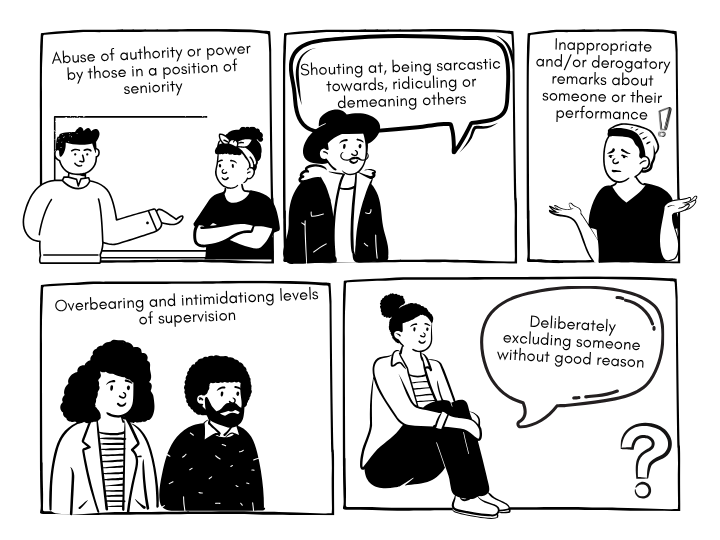
The key is that the conduct is viewed as demeaning and unacceptable to the recipient.
|
Deliberate physical and/or verbal abuse including embarrassing or derogatory remarks, jokes, name-calling and obscene gestures |
Ridiculing an individual because of physical differences, the way they present their masculinity or femininity, in terms of dress or attitude |
Making stereotypical assumptions about colleagues, friends or members of the public based on their sexuality |
|
Deliberate interference with wheelchair or support equipment |
Racist, sexist, homophobic or ageist 'jokes', or derogatory or stereotypical remarks about a particular ethnic or religious group or gender |
Outing or threatening to out someone as LGBTQ+ |
|
Ridiculing an individual because of the way they dress or their religious observance customs |
Using blasphemous or offensive language against any religion or belief, or making inappropriate or derogatory references to religious figures or customs |
any unwanted behaviour that can make you feel distressed or scared |
Stalking is a form of harassment, where the stalker has an unwanted obsession with the person they're targeting and their repeated, unwanted behaviour can make the victim feel distressed or scared.
Stalking may include:
- Following someone
- Contacting, or attempting to contact, a person by any means
- Publishing any statement or other material relating or purporting to relate to a person, or purporting to originate from a person
- Going uninvited to their home
- Hanging around somewhere they know the person often visits
- Watching or spying on someone
- Identity theft (signing-up to services, buying things in someone's name)
- Writing or posting online about someone if it's unwanted or the person doesn't know
- Cyber stalking, which can include the use of social networking sites, email, chat rooms and other forums facilitated by technology
If the unwanted behaviour has happened two times or more and made you feel scared, distressed or threatened it may be stalking so report it.
If you, or someone you know, have been affected by bullying, harassment, stalking or any other form of sexual misconduct, it may be hard to know what to do or how to feel. That's okay.
What happened was not your fault, you're not alone, and what you do next will always be your choice.
Are you in Immediate Danger?
You Report, We Support is not an emergency reporting tool.
If you are in immediate danger or seriously injured:
- Contact the Emergency Services on 999
Alternatively, if you are on campus you can call
- On Campus Security: Lancaster 07809 190566, Carlisle 07809 190530, Ambleside 07809 190531
If you are Deaf, deafened, hard of hearing or have a speech impairment, a Text Phone is available on: 18000
Find a Safe Space
- Find a Safe Space: try to find a space which makes you feel most comfortable and safe from harm.
- You may find it useful to think about what is meant by bullying and harassment, and examples of these behaviours.
If you are not in immediate danger, currently feel safe from harm and do not need to report an emergency - then speaking to someone about your options is a great place to start.
-
Report an incident: If you submit a report with details, a member of the Student Services team will be in touch soon. Your report will not trigger a formal complaints process, and the advisor can confidentially speak to you about both your reporting and support options. You will never be forced to submit a report to the police, or a Formal Complaint to the University- as this is your choice.
-
The University of Cumbria Student's Union can provide support, advocacy and advice to students even if they do not wish to report.
-
If you are a member of staff and have opted to join one of the three unions recognised by the University; UCU, Unite and UNISON, they will be able to offer advice, advocacy and support. All help and advice from unions is independent of the University of Cumbria.
-
Victim Support: is the independent charity for people affected by crime and traumatic events in England and Wales. Their support is free and confidential.
It is entirely within your right to formally report Sexual Misconduct. You can formally report something to the University and/or the police if it constitutes a criminal offence.
-
Report an Incident: If you submit a report with details, a member of the Student Services team will be in touch soon. Student Services advisors can help outline your formal reporting options, as well as describing what these processes might look like and what an investigation would entail.
We would strongly advise seeking the support of a Student Services Advisor if you wish to report something to the police.
- Report Harassment to the Police: Harassment is both a criminal offence and a civil action under the Protection from Harassment Act 1997. This means that someone can be prosecuted in the criminal courts if they harass you. It also means you can take action against the person in the civil courts. Generally speaking harassment is behaviour which causes you distress or alarm. The Act also says you must have experienced at least two incidents by the same person or group of people for it to be harassment. It's the courts that decide if something is harassment under the Act. The courts will look at whether most people or a reasonable person would think the behaviour amounts to harassment.
If you would like to speak to someone about how the incident(s) has emotionally affected you, or you would like to use some of the support services below for self-care, that is okay.
- Report an Incident: If you submit a report with details, a member of the Student Services team will be in touch soon. Please remember that submitting a report with details through Report and Support, means that someone will be able to personally talk you through your support options and tailor advice to your needs. You will never be forced to submit a formal report.
- Wellbeing Support Services: The University’s dedicated wellbeing services can support you with practical and emotional issues impacting your wellbeing or mental health and aspects of University life, including referrals for counselling and psychology support.
- Students’ Union: Is the SU's Advice Centre with expert staff who can provide support, advocacy and advice to students even if they do not wish to report.
- Personal Tutors: If your studies have been affected by an incident, your personal tutor could help to explain your options with regards to academic support.
- Togetherall: Both students and staff can access the online community, which supports populations with their mental health and wellbeing – helping with feels of anxiety, depression, isolation and stress, to relationship problems and lifestyle challenges. Togetherall have a network of trained professionals providing 24/7 support around the world.
It is okay not to want to do anything at this moment in time. It is entirely your choice.
If you ever change your mind, just know these support pages will be here to help direct you towards whichever option you wish to pursue.
Looking For Further Information?
The page references a range of national bodies and local groups who are committed to community engagement, social justice and more. This collection aims to empower students and staff with knowledge, foster inclusive practices, and provide pathways for support and action. It reflects the university’s broader mission to create a welcoming, equitable environment for all.